Protein-ligand binding kinetics setup with Seekrflow and Asyncflow
In this example, we will prepare, run, and analyze calculations to predict binding and unbinding kinetics for a host-guest system - a common benchmark system for computational methods to predict biomolecular interactions.
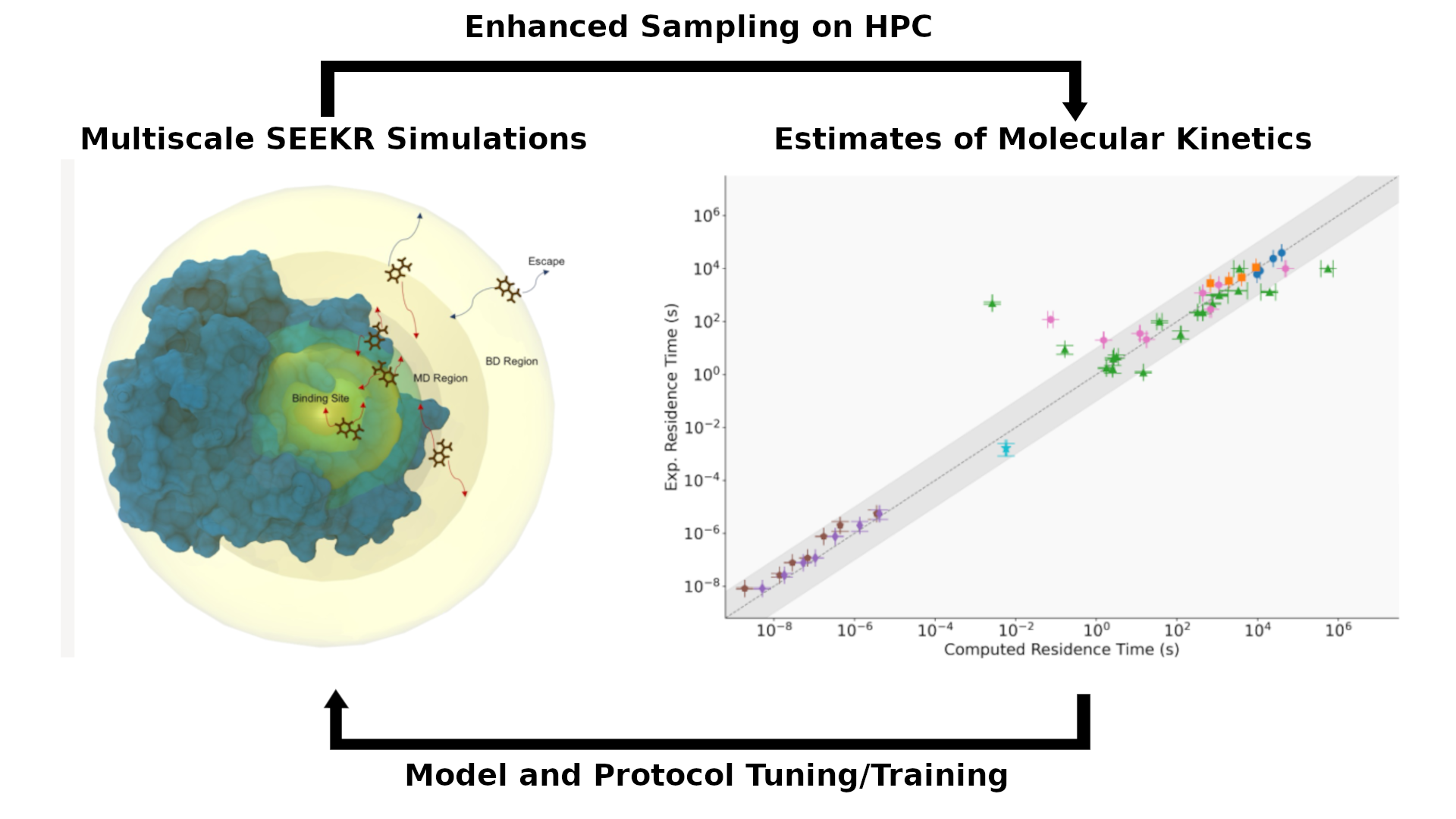
We will use two SINAPSE SDK components:
Seekrflow performs the calculations that will predict the kinetics.
Asyncflow an asynchronous workflow layer for Seekrflow pipeline.
Prerequisites
These calculations will run on your local Linux machine, although additional configuration can allow running on remote compute resources.
Install
The easiest, quickest way to install seekrflow is to use Mamba. If you don’t already have Mamba installed, Download the Miniforge install script and run.
curl -O https://github.com/conda-forge/miniforge/releases/latest/download/Miniforge3-$(uname)-$(uname -m).sh
bash Miniforge3-$(uname)-$(uname -m).sh
Once this has been done, set up a new environment:
mamba create -n SEEKR python=3.12 --yes
This step installs seekrflow from github.
mamba activate SEEKR
git clone https://github.com/seekrcentral/seekrflow.git
cd seekrflow
python -m pip install .
Next, install seekr:
mamba install seekr
One will also need to install OpenMM:
mamba install openmm
You may wish to specify the cuda version for your pre-installed version.
mamba install openmm cuda-nvrtc=##.# cuda-version=##.#
Where, of course, you replace the ‘##.#’ with whatever Cuda version you have
installed, found using nvidia-smi or other such program.
Run Example
Next, find the host-guest example directory and run the example:
seekrflow/seekrflow/examples/host_guest
python ~/seekrflow/seekrflow/flow.py prepare -i seekrflow_1_butanol_local.json
python ~/seekrflow/seekrflow/flow.py run -i seekrflow_1_butanol_local.json
python ~/seekr/seekr/analyze.py work/root/model.json
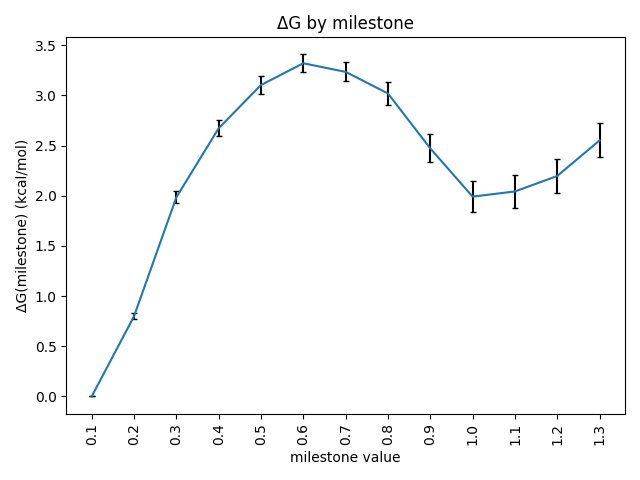
You will see the analysis printed to the screen. If you’re curious, the experimentally-measured k-off for this compound is 3.8e8 1/s. This calculation is artificially truncated for demonstration purposes - a true seekr calculation should simulate much longer. The generated images can be seen in ~/test_seekr/images_and_plots.